
Frankfurt old map
Two historical plans on this page show Frankfurt before industrialisation: a hand-coloured 18th-century engraving by the Augsburg publisher Matthäus Seutter, and a detailed steel engraving published in London in 1837.
Frankfurt is first recorded in 794 as Franconofurd, the "ford of the Franks", when Charlemagne held a church council there. It later became a free imperial city, the place where German kings and emperors were elected and, from 1562 to 1792, also crowned. Its trade fairs, recorded since the Middle Ages, made it a commercial centre long before the banks arrived.
In 1866 the city was annexed by Prussia, and in the Second World War air raids destroyed most of the medieval Altstadt. Comparing these old plans with a modern map shows how the ramparts became the park ring and how much of the old street pattern disappeared.
Frankfurt historical map
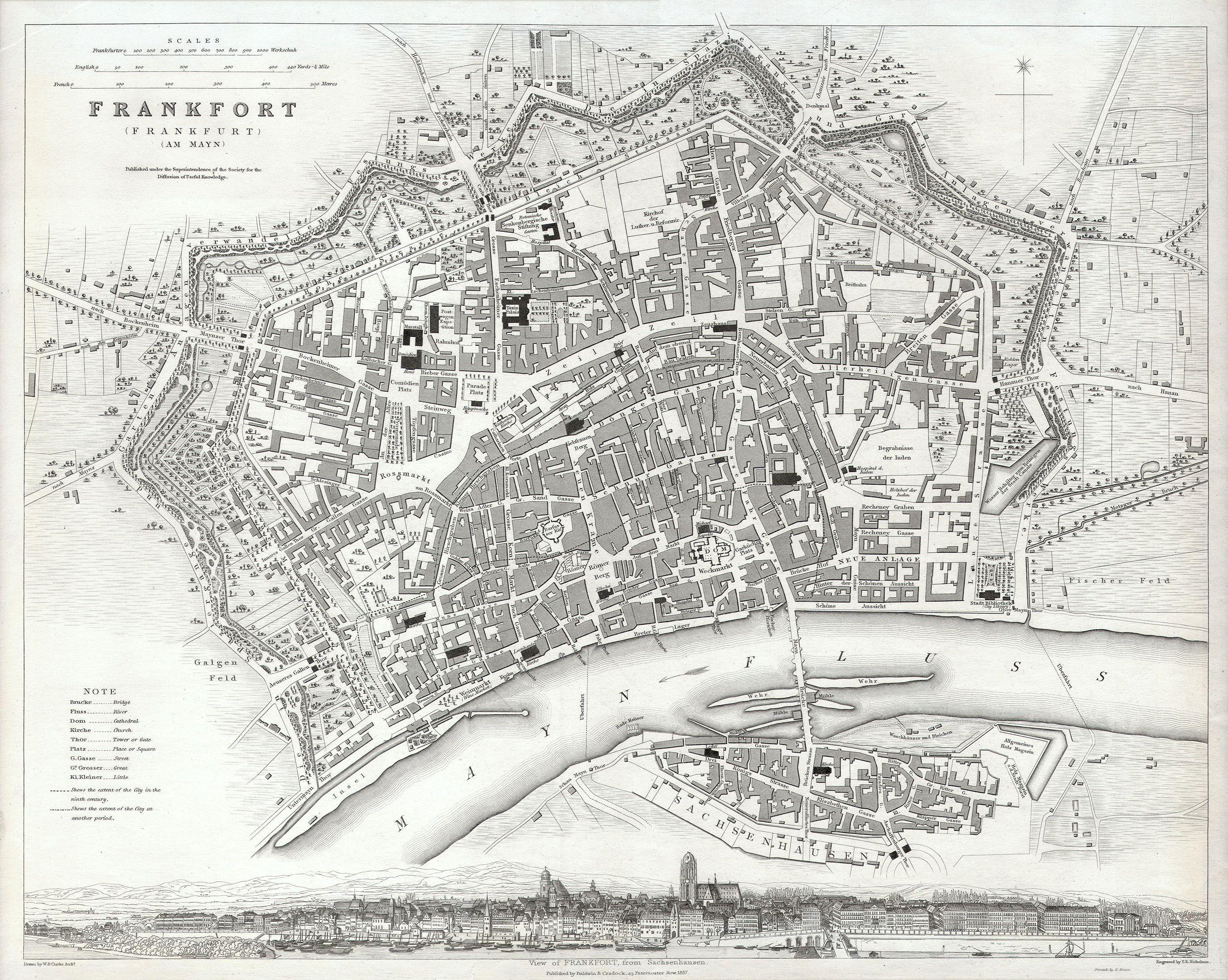
Map of Frankfurt historical
A steel-engraved plan of Frankfurt published in London in 1837 by the Society for the Diffusion of Useful Knowledge, titled "Frankfort (Frankfurt) am Mayn", with a panoramic view of the city from Sachsenhausen along the bottom.
The city is still enclosed by its former fortifications, which had already been turned into landscaped walks, and Sachsenhausen lies on the south bank of the Main, linked by a single bridge, the Alte Brücke. A note explains German map terms such as Thor (gate), Platz (square) and Gasse (lane), and dotted lines show how far the city extended in the 9th century.
Frankfurt vintage map

Map of Frankfurt antique
A hand-coloured bird's-eye plan of Frankfurt by the Augsburg engraver Matthäus Seutter, from about 1740, with its Latin and German title describing the free imperial city of elections and coronations.
Star-shaped bastions surround both Frankfurt and Sachsenhausen, and a lettered key identifies churches, monasteries and public buildings. Below the plan, three vignettes show an imperial procession, a panorama of the city from the river and an allegorical scene of trade.